Above:
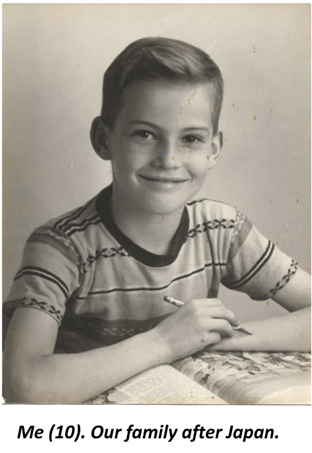
Me, ten years old Below:
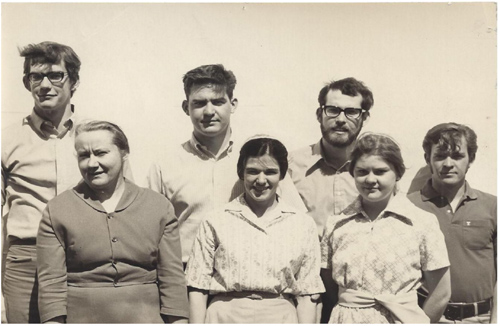
Our family after my tour in Japan. The year
is 1969. Back Row (left to right): my three
brothers and me. Herb, Clayte, Myself, Joe.
Front Row: Mom, Clayte’s new bride Mary
Lou and my sister Sally. |
I grew up on a 128-acre dairy farm at the foot
of the Blue Mountains in Lebanon County, Pennsylvania.
My parents affiliated with a very conservative
Mennonite community. The rhythm of the farm
(milkings, planting and harvesting) and the
discipline of the Mennonites (revival meetings,
plain clothes and conscientious objection to
war) fenced our life. But daily life was rich—our
farm was overrun with cows and rabbits and chickens.
We spent holidays with wonderful cousins and
aunts and grandparents.
I hated farm work and resolved early on it wasn’t
for me. I spent a great deal of my boyhood escaping
into novels when I was supposed to be cultivating
the corn. Early on I felt a thirst for the Larger
World. I scribbled out my first stories when
I was ten and took them to family reunions,
where I read them aloud to my cousins. They
asked for more!
In Japan, where I landed after college (Eastern
Mennonite), I lived with the Yamaguchi Family
and became fluent in Japanese. However, Japan
was a parenthesis, I thought, irrelevant to
becoming a famous writer, like the literary
giants we’d studies in college: Dostoevsky,
William Faulkner . . . .I returned to the U.S.
in time to participate in the Mennonite Renaissance
of the Seventies. Mennonites were overthrowing
the rule of the conservative bishops and indulging
in the arts. I saw my first movie at 22. Merle
Good’s Dutch Family Festival ran plays
on Mennonite themes. Tens of thousands of tourists
were descending on Lancaster County every summer
and paying good money ‘to see the Amish’
– I wrote my first historical novel, Mennonite
Soldier.
When the Mennonite Publishing House rejected
my second novel as ‘vulgar and anti-Mennonite’,
I was stunned. I fled to San Francisco with
my new California wife.
San
Francisco was my first American city. I had
lived in three Japanese cities, including Tokyo,
the world’s largest city in the 1970’s.
But nothing prepared me for the raw discrimination
that Harry Chuck, my first employer in San Francisco,
was introducing me to. How was it our U.S. history
texts never mentioned the Chinese Exclusion
Act, which barred any new Chinese immigrants
from 1875 to 1943? Or of the murderous mobs
who chased Chinese off goldrush claims and lynched
dozens of them?
|